
The Ark of the Covenant is one of the most sacred objects described in the Old Testament. It was not a decoration, a symbol of superstition, or an object Israel was supposed to worship. It was a holy chest made by commandment of God, placed in the most sacred part of the tabernacle, and associated with the covenant relationship between the Lord and ancient Israel.
From a Latter-day Saint perspective, the Ark also points beyond itself. Like many parts of the law of Moses, it taught through physical symbols. It helped Israel understand holiness, covenant, priesthood, sacrifice, mercy, and the presence of God.
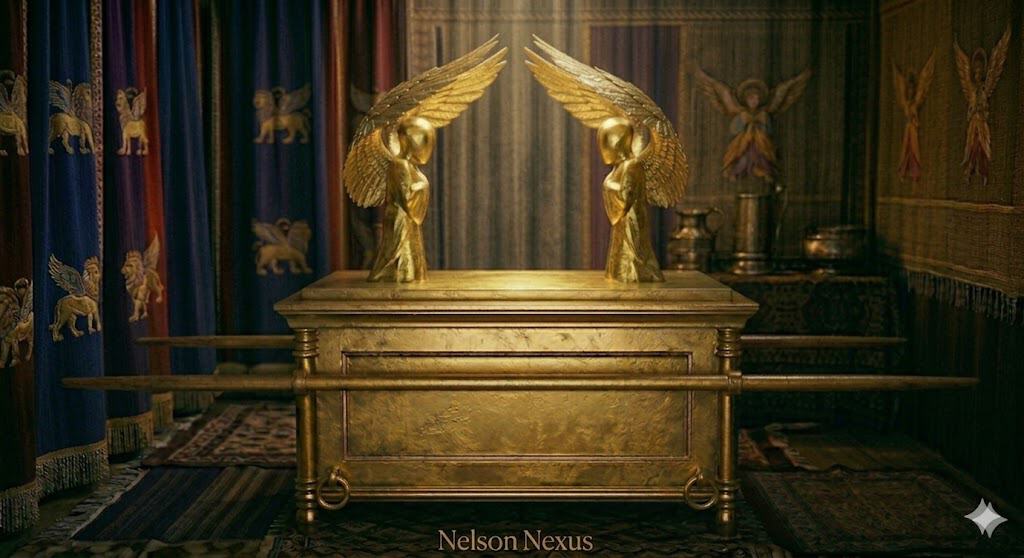
What Was the Ark of the Covenant
The Ark of the Covenant was a sacred chest built during the time of Moses. The Lord gave the instructions for it after Israel came out of Egypt and entered into covenant with Him at Mount Sinai.
In Exodus 25:10, the Lord commanded Moses, “And they shall make an ark of shittim wood.” Shittim wood is commonly understood as acacia wood. The Ark was to be overlaid with pure gold inside and outside, with a crown of gold around it.
The Lord also gave the dimensions: “two cubits and a half shall be the length thereof, and a cubit and a half the breadth thereof, and a cubit and a half the height thereof” (Exodus 25:10).
That means the Ark was rectangular, longer than it was tall. It was not described as a massive box, throne, altar, or statue. It was a sacred chest, carefully constructed according to a revealed pattern.
Why Was the Ark Needed
The Ark was needed because Israel was learning how to live as a covenant people in the presence of a holy God.
The children of Israel had been delivered from Egypt, but deliverance was not the end of the story. God was teaching them how to worship, how to remember His commandments, how to approach Him, and how to understand holiness.
The Ark stood at the center of that system of worship. It was placed in the most sacred room of the tabernacle, called the most holy place or Holy of Holies. Exodus 26:33 says the veil would divide between “the holy place and the most holy,” and the Ark was placed behind that veil.
The Ark represented the Lord’s covenant presence among His people. In Exodus 25:22, the Lord said, “And there I will meet with thee, and I will commune with thee from above the mercy seat, from between the two cherubims.”
That verse is one of the most important keys to understanding the Ark. The Ark did not contain God. It represented the place where God would meet with His authorized servant and speak to Israel.
How Was the Ark Created
The Ark was created according to specific instructions from the Lord. Exodus 25 gives the commandment. Exodus 37 describes the construction.
Bezaleel made the Ark of shittim wood, overlaid it with pure gold, made the golden crown around it, cast four rings of gold, and made staves of shittim wood overlaid with gold (Exodus 37:1–5).
The carrying poles mattered. The Ark was not supposed to be casually touched or handled. Exodus 25:15 says, “The staves shall be in the rings of the ark: they shall not be taken from it.”
This detail teaches reverence. Sacred things were not treated as common things. Even the way the Ark was moved taught Israel that holiness required order, authority, and care.
What Was Inside the Ark
The most important item placed inside the Ark was the testimony, or the stone tablets containing the law. Exodus 25:16 says, “And thou shalt put into the ark the testimony which I shall give thee.”
Deuteronomy 10:5 says Moses put the tables in the Ark after receiving them from the Lord.
Hebrews 9:4 also mentions three sacred items associated with the Ark:
“the golden pot that had manna, and Aaron’s rod that budded, and the tables of the covenant.”
Each item carried meaning.
The tables of the covenant represented God’s law and Israel’s covenant obligations.
The pot of manna reminded Israel that the Lord had fed them in the wilderness.
Aaron’s rod that budded reminded Israel that priesthood authority came from God, not from human ambition.
Together, these items taught Israel to remember God’s commandments, God’s provision, and God’s authority.
The Mercy Seat
The lid of the Ark was called the mercy seat. Exodus 25:17 says, “And thou shalt make a mercy seat of pure gold.”
This was not simply a decorative lid. It was the sacred covering placed over the Ark. The LDS Old Testament Student Manual explains that the Hebrew word translated as “mercy seat” in the King James Version carries the meaning of a “seat of atonement.”
That matters deeply. The mercy seat symbolized the place where mercy, covenant, and atonement came together.
Inside the Ark were the commandments, reminding Israel of God’s law. Above the Ark was the mercy seat, reminding Israel that God’s mercy and atonement were essential. The image is powerful: law below, mercy above.
From a Christian perspective, this naturally points to Jesus Christ. He does not destroy the law of God. He fulfills it. He offers mercy through His Atonement.
The Cherubim
Two cherubim were placed on the mercy seat. Exodus 25:18 says, “And thou shalt make two cherubims of gold, of beaten work shalt thou make them.”
The Bible does not give a full physical description of these cherubim. It does say they were made of gold, placed on the two ends of the mercy seat, faced one another, and looked toward the mercy seat.
Exodus 25:20 says, “And the cherubims shall stretch forth their wings on high, covering the mercy seat with their wings.”
This is why many visual reconstructions show the wings rising upward and inward over the mercy seat. The cherubim functioned as sacred guardians of the divine presence, similar to the cherubim placed at the east of the Garden of Eden in Genesis 3:24.
What the Ark Symbolized
The Ark was rich with symbolism, but let’s be careful not to invent details the Bible does not give. The strongest symbolism comes directly from what the scriptures say about its materials, contents, location, and use.
Gold
The Ark was overlaid with pure gold inside and outside. Gold often suggests holiness, glory, and divine majesty. In the tabernacle, the closer one moved toward the most holy place, the more sacred and precious the materials became.
Shittim Wood
The Ark was made of wood and overlaid with gold. This combination can suggest something mortal covered with divine glory, though the Bible does not explicitly explain the symbolism of the wood itself.
The Law Inside the Ark
The tables of the covenant showed that God’s commandments were at the heart of Israel’s covenant life. The Ark was not empty. It carried the testimony of God’s revealed law.
The Mercy Seat Above the Law
The mercy seat rested above the testimony. This is one of the most beautiful symbols in the Ark. God’s law was real, but so was His mercy. In Jesus Christ, justice and mercy meet.
The Cherubim
The cherubim marked the sacredness of God’s presence. They remind us that God is loving, but He is also holy. His presence is not approached casually.
The Holy of Holies
The Ark was placed behind the veil in the most sacred part of the tabernacle. This pointed to the idea that entering God’s presence required holiness, covenant, priesthood authority, and atonement.
Walking Through the Image
In the image, the Ark is shown as a gold-covered rectangular chest. This reflects the instruction in Exodus 25 that the Ark be made of shittim wood and overlaid with pure gold.
The long poles passing through the rings show how the Ark was carried. The poles were not optional accessories. They were part of the Lord’s command, and they helped prevent unauthorized touching of the Ark.
The flat gold covering on top represents the mercy seat. This was the place where the Lord said He would commune with Moses from between the cherubim.
The two winged figures represent the cherubim. Their wings stretch upward and inward over the mercy seat, reflecting Exodus 25:20. Their faces turn toward the mercy seat, also matching the biblical description.
The curtains in the background represent the tabernacle setting. Exodus 26 describes curtains of blue, purple, and scarlet, with cherubim worked into them. These colors and designs helped mark the tabernacle as sacred space.
The light descending between the cherubim is an artistic way of representing the presence of the Lord. The Bible does not give us a detailed visual description of that light in Exodus 25, so this part of the image should be understood as symbolic rather than literal.
Was the Ark Worshipped
The Ark was sacred, but it was not God. Israel was not commanded to worship the Ark. They were commanded to worship the Lord.
This distinction matters because sacred symbols can be misunderstood. In 1 Samuel 4, Israel brought the Ark into battle as though its presence alone would guarantee victory. But the people were defeated, and the Ark was captured by the Philistines.
That story teaches a sobering lesson. Sacred objects do not replace faithfulness. Ordinances, temples, scripture, and symbols are meant to point us to God, not become substitutes for Him.
What Happened to the Ark
The Ark appears many times in the Old Testament. It went before Israel in the wilderness, was associated with the crossing of Jordan, was present in the account of Jericho, was captured by the Philistines, was returned to Israel, and was eventually brought to Jerusalem.
Later, Solomon placed the Ark in the temple. In 1 Kings 8:6, the priests brought the Ark “unto his place, into the oracle of the house, to the most holy place.”
The final location of the Ark is not clearly explained in the Bible. Many theories exist, but the scriptural record does not give a definitive answer about what ultimately happened to it.
Why the Ark Still Matters
The Ark matters because it teaches the pattern of coming into God’s presence.
It teaches that God makes covenants with His people.
It teaches that commandments matter.
It teaches that mercy is necessary.
It teaches that priesthood authority is sacred.
It teaches that God wants to dwell among His people.
Most importantly, it points us to Jesus Christ. The Ark was part of the law of Moses, and the law of Moses pointed forward to Christ. Through Him, mercy is made possible. Through Him, covenant becomes more than a rule. It becomes a relationship with God.
The Ark of the Covenant was not merely an ancient religious artifact. It was a witness. It testified of law, mercy, holiness, priesthood, covenant, and the presence of the Lord among His people.