
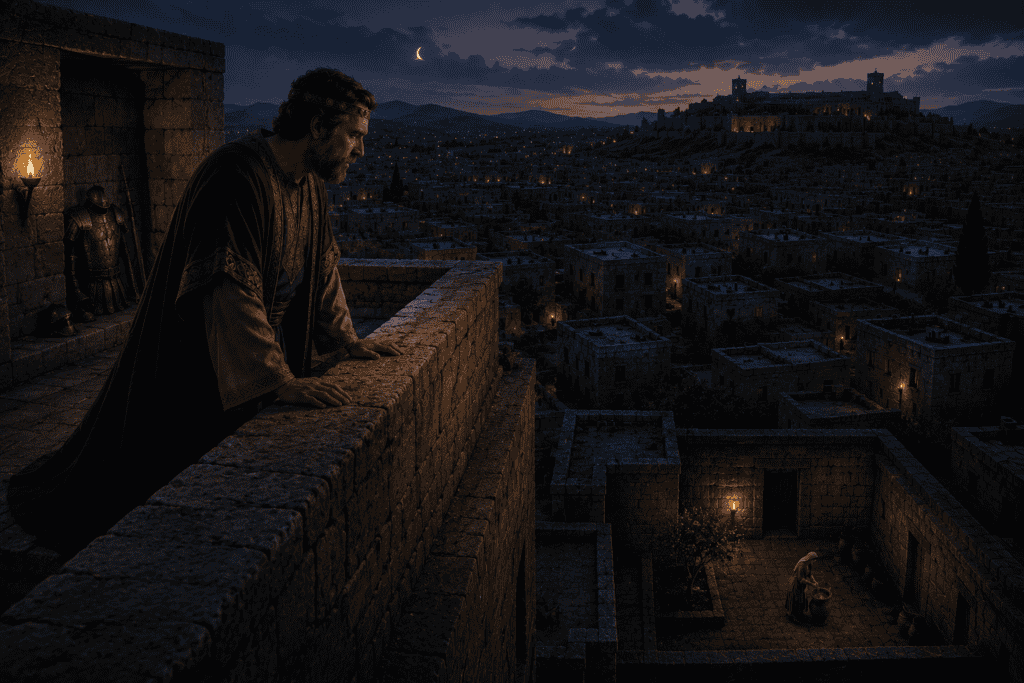
“And it came to pass in an eveningtide, that David arose from off his bed, and walked upon the roof of the king’s house…” (2 Samuel 11:2)
When I generated the image at the top of this article, I wasn’t trying to recreate the famous story of David and Bathsheba.
I was trying to capture something much quieter.
The moment before everything changed.
Most paintings of this story focus on Bathsheba. They make her the center of attention.
But Scripture doesn’t.
The biblical narrative spends remarkably little time describing Bathsheba. Instead, it follows David’s choices one by one.
He stayed home.
He wandered the roof.
He noticed.
He lingered.
Everything else came later.
The Image Tells a Different Story
In this image, Bathsheba is almost lost in the scene.
She is far below in what appears to be a private courtyard, quietly performing what may have been a ceremonial washing after her monthly purification, something the text itself alludes to. She appears completely unaware that anyone can see her.
David, however, dominates the frame.
Not because he is the hero.
Because he is the one making a decision.
Behind him rests his unused armor.
That detail isn’t in the biblical text, but it illustrates the opening verse perfectly:
“At the time when kings go forth to battle… David tarried still at Jerusalem.”
Before David committed adultery…
Before he lied…
Before he orchestrated Uriah’s death…
He simply wasn’t where he should have been.
Satan Rarely Starts With the Worst Sin
One of the greatest lies we tell ourselves is that great sins happen suddenly.
They usually don’t.
Imagine if Satan had whispered to David:
“Tonight, I’d like you to commit adultery, deceive your closest friends, manipulate your military commander, arrange the death of one of your most loyal soldiers, and spend nearly a year hiding it.”
David would likely have recoiled.
That isn’t how temptation works.
Instead, it sounds much smaller.
“Stay home.”
“Take a walk.”
“Just look.”
“Just another second.”
The temptation isn’t the murder.
The temptation is remaining at the wall.
James describes this progression beautifully:
“Every man is tempted, when he is drawn away of his own lust, and enticed. Then when lust hath conceived, it bringeth forth sin…” (James 1:14–15)
Sin grows.
It almost never explodes.
A Flaxen Cord
One verse from the Book of Mormon came to my mind as I looked at this image:
“He leadeth them by the neck with a flaxen cord, until he bindeth them with his strong cords forever.” (2 Nephi 26:22)
A flaxen cord is almost laughably weak.
You wouldn’t fear it.
You might not even notice it.
That’s the point.
Satan doesn’t usually begin with chains.
He begins with something so small that it feels harmless.
A lingering glance.
A rationalization.
A secret.
A compromise.
Only later do those nearly invisible cords become chains.
David didn’t wake up intending to become an adulterer or a murderer.
He simply didn’t break the first cord.
The Mercy Hidden in the Story
The encouraging part of David’s story is that every step before the final act was another opportunity to turn around.
He could have walked away after the first glance.
He could have stopped after learning Bathsheba was Uriah’s wife.
He could have confessed when she became pregnant.
He could have refused to involve Joab.
He could have honored Uriah’s integrity.
Every stage was another invitation to repent.
Sin narrows our vision until we believe the next compromise is our only option.
God continually offers another path.
Why This Image Matters
I think this image succeeds because it doesn’t invite us to look at Bathsheba.
It invites us to examine David.
And, if we’re honest, ourselves.
Most of us won’t face David’s exact temptation.
But every one of us has stood at a rooftop.
We’ve all had moments where no one else knew the battle taking place inside our own hearts.
Those are the moments that shape a life.
Long before anyone else sees the consequences.
Long before the flaxen cord becomes a chain.