If you’ve ever tried to read Exodus 25–40 in the Bible, you know it can feel overwhelming. Measurements, materials, repeated instructions, and unfamiliar terms can make it hard to see what’s actually happening.
But when you step back, it becomes something much simpler and more powerful.
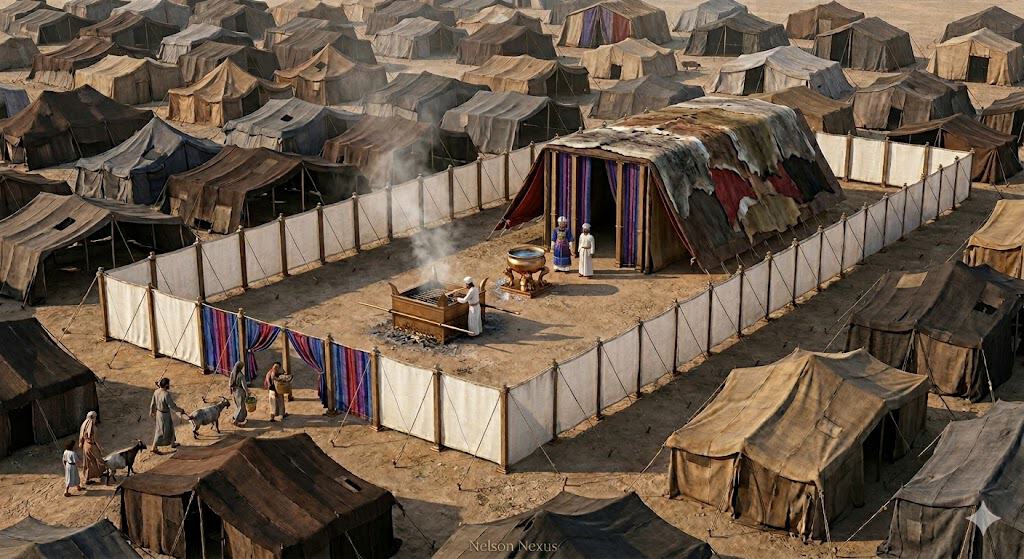
This image represents the Tabernacle, the center of worship for the children of Israel under the law of Moses. Everything happening here was designed to teach one thing:
Jesus Christ was coming.
What Was the Law of Moses?
The law of Moses was a system of commandments, ordinances, and sacrifices given by God to the children of Israel after they left Egypt.
It included:
- Daily and periodic sacrifices
- Strict rules about cleanliness and obedience
- A central place of worship, the Tabernacle
But the key point is this:
The law of Moses was not the final gospel. It was a preparatory law.
Galatians 3:24 (KJV)
“Wherefore the law was our schoolmaster to bring us unto Christ…”
In other words, it was designed to teach and point people toward Christ.
Why Did They Offer Animal Sacrifices?
At the center of the law of Moses was sacrifice.
Animals were offered because:
- Sin requires a cost
- Innocent blood was shed
- It symbolized a future sacrifice
Exodus 29:18 (KJV)
“…it is a burnt offering unto the Lord: it is a sweet savour…”
These sacrifices were symbolic of Jesus Christ, who would later offer Himself as the final and infinite sacrifice.
What Are We Seeing in This Image?
This scene shows a simplified view of how worship worked at the Tabernacle.
Let’s walk through it from the entrance inward.
1. The Gate (Entrance to the Courtyard)
This is the only way in.
People would come bringing offerings such as:
- Lambs
- Goats
- Grain
Not everyone just wandered in. Worship was intentional and structured.
2. The Altar of Burnt Offering
This is where sacrifices were made.
Exodus 27:1–2 (KJV)
“And thou shalt make an altar… and thou shalt make the horns of it…”
Here:
- The animal was sacrificed
- Blood was shed
- The offering was burned
This symbolized giving something of value to God and pointed forward to Christ’s sacrifice.
3. The Laver (Wash Basin)
Between the altar and the Tabernacle was a basin of water.
Exodus 30:18 (KJV)
“Thou shalt also make a laver of brass… for washing…”
Priests used this to wash before entering the Tabernacle.
This represents:
- Cleansing
- Preparation
- Becoming spiritually clean
4. The Tabernacle (The Tent)
This is where things become more restricted.
Not everyone could enter.
The Holy Place
Only priests could enter this first room.
Inside were:
- The candlestick (light)
- The table of shewbread
- The altar of incense
These represented:
- Light and truth
- Sustenance from God
- Prayers rising to heaven
The Most Holy Place (Holy of Holies)
Behind a veil was the most sacred space.
Inside was the Ark of the Covenant.
Exodus 40:21 (KJV)
“And he brought the ark into the tabernacle, and set up the vail…”
Only the high priest could enter here, and only at specific times.
This represented the presence of God.
Did Every Family Offer Sacrifices?
Yes, families participated in sacrifices, but:
- They did not perform all the rituals themselves
- Priests handled the sacred ordinances
- Offerings varied depending on the situation (sin offerings, peace offerings, etc.)
So while many people brought sacrifices, not everyone did everything.
Who Could Enter Where?
There were clear boundaries:
- The general people could enter the courtyard
- Only priests could enter the Tabernacle (Holy Place)
- Only the high priest could enter the Most Holy Place
This structure taught something important:
Access to God was limited under the law of Moses.
Why Don’t We Follow the Law of Moses Today?
Because Jesus Christ fulfilled it.
3 Nephi 9:19 (Book of Mormon)
“I will accept none of your sacrifices and your burnt offerings…”
Matthew 5:17 (KJV)
“I am not come to destroy, but to fulfil.”
Christ’s Atonement was:
- Infinite
- Final
- Complete
After His sacrifice:
- Animal offerings were no longer needed
- The symbols were fulfilled
What Replaced It?
Instead of outward sacrifice, God now asks for something inward.
3 Nephi 9:20
“Ye shall offer for a sacrifice unto me a broken heart and a contrite spirit.”
This means:
- Humility
- Repentance
- Willingness to change
- Surrendering our will to God
What This Image Really Represents
This is not just an ancient religious scene.
It is a visual teaching tool.
Everything here points forward to Christ:
- The altar → His sacrifice
- The laver → spiritual cleansing
- The veil → separation from God
- The Holy of Holies → God’s presence
And Christ changed everything.
Because of Him:
- The veil is no longer a barrier
- The sacrifice has already been made
- Access to God is open through Him
Final Thought
The law of Moses was never about animals, rituals, or strict rules for their own sake.
It was about preparing hearts.
And today, instead of bringing a lamb to an altar, we bring something much more personal:
A broken heart and a contrite spirit.