
The story of the ten plagues of Egypt is one of the most powerful and symbolic accounts in the Bible. Found in Exodus, these events mark the moment when Moses, under the direction of the Lord, confronted Pharaoh and called for the release of the Israelites.
Each plague builds upon the last, not just as a display of power, but as a message. Together, they tell a story of resistance, consequence, and ultimately, deliverance.
Below is a visual breakdown of the ten plagues, designed to make the sequence easy to understand at a glance.
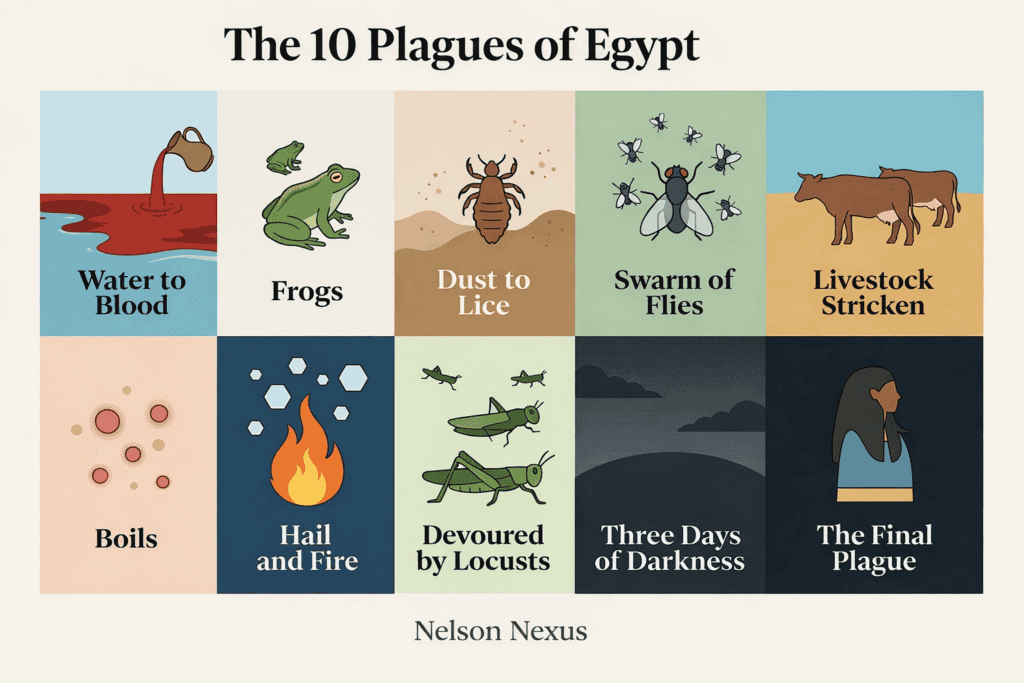
The 10 Plagues of Egypt Explained
Water to Blood
The Nile River, Egypt’s primary source of life, was turned to blood, making the water undrinkable and killing fish.
Frogs
Frogs covered the land, entering homes and disrupting daily life across Egypt.
Dust to Lice
Dust from the ground became lice, affecting both people and animals.
Swarm of Flies
Flies filled Egyptian homes and land, while the Israelites were spared.
Livestock Stricken
Egyptian livestock fell ill and died, impacting food supply and economy.
Boils
Painful sores broke out on people and animals throughout Egypt.
Hail and Fire
A destructive storm of hail and fire destroyed crops and land.
Devoured by Locusts
Locusts consumed what remained of Egypt’s vegetation.
Three Days of Darkness
A deep darkness covered Egypt for three days, while the Israelites had light.
The Final Plague
The death of the firstborn led Pharaoh to finally release the Israelites.
Why Does the Bible Say the Lord Hardened Pharaoh’s Heart?
One of the most discussed parts of the Exodus story is the repeated phrase in the King James version that the Lord hardened Pharaoh’s heart. For example, Exodus 4:21 states, “I will harden his heart, that he shall not let the people go,” and Exodus 9:12 says, “the Lord hardened the heart of Pharaoh.”
At the same time, the text also shows Pharaoh hardening his own heart. Exodus 8:15 says “he hardened his heart,” and Exodus 9:34 adds that “he sinned yet more, and hardened his heart, he and his servants.” This pattern appears throughout the account, showing Pharaoh repeatedly choosing to resist even after witnessing each plague.
In the Joseph Smith translation, several of these verses are clarified to emphasize Pharaoh’s agency. Rather than stating that the Lord caused his heart to harden, the wording in key places shifts to show that Pharaoh hardened his own heart. This aligns with a broader principle taught in scripture that individuals are accountable for their own choices.
Taken together, many understand these verses to mean that while God allowed events to unfold and continued to send signs through Moses, Pharaoh repeatedly chose not to listen. Over time, that pattern of resistance led to a hardened heart, not because it was forced upon him, but because it followed repeated choices to resist.
Why This Story Still Matters
The plagues of Egypt are not just historical or symbolic events. They represent themes that still resonate today, including agency, consequences of repeated choices, and the power of deliverance.
Whether viewed through a spiritual, historical, or educational lens, this story continues to be one of the most recognized and meaningful narratives in scripture.